How Many People Does 1kg of Snow Crab Feed? A 25-Year Crab Seller's Field Guide
1kg of live snow crab fills one adult; two people share it as a taste. A 25-year seller in Gijang, Busan explains meat yield, per-person ordering weights,
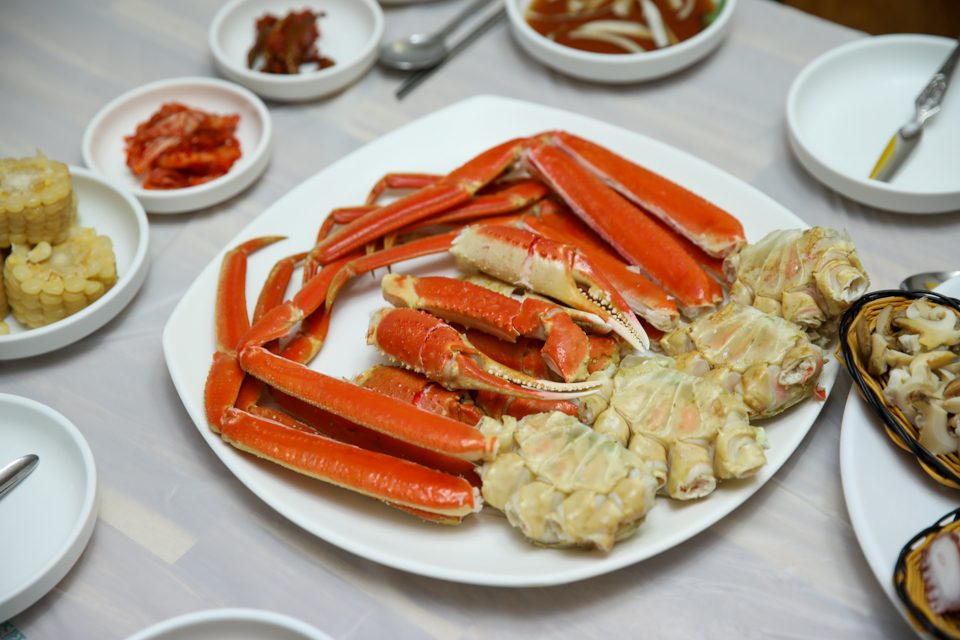
One kilogram of live snow crab is enough to fill up one adult, or give two people a good taste. Depending on how full the shell is, two crabs of the same weight can differ by as much as half in the amount you actually eat. That is why you should look at meat yield before you look at weight.
This is the question I hear most often in front of the tank. “How many people does 1kg feed?” I have been selling crab for 25 years, and I still cannot answer that in a single sentence. The reason is that I cannot bring myself to lie. Put two 1kg crabs side by side, and one of them can feed two people with leftovers, while the other leaves a single person wanting more.
Instead, in this article I will give you the exact explanation I give my customers at the scale every day. How weight turns into meat, how much to order for each party size, and what to check before the crab goes on the scale so you do not lose out. Read it all the way through, and you will not be second-guessing yourself in front of any tank.
What this article covers
- What 1kg on the scale really means
- Meat yield decides how much you eat
- Ordering guide by party size
- How much meat each part gives you
- Three things to check at the scale
- How to factor in the side dishes
- When there is too much, and when there is not enough
- Frequently asked questions
What 1kg on the scale really means
Let me clear up a misunderstanding first. The 1kg that shows on the scale is not 1kg of meat. It is the shell, the gills, the innards, and all the water inside the body, added together.
The parts of a snow crab you actually eat, meaning the leg meat, the body meat, and the tomalley inside the top shell, come to roughly a third of the total weight. A crab in good condition gives you more than that, and one that has taken on a lot of water gives you far less. If you buy 1kg, figure that a little over 300g actually goes into your mouth, and your math will come out right.
To give you a sense of what 300g means, a bowl of rice is about 200g. If you are eating nothing but the crab, that is enough to fill one adult properly. If you take your time picking the meat over a bottle of soju, two people can stretch it into an hour. That is why the answer to “how many servings” depends on how you plan to eat.
Meat yield decides how much you eat
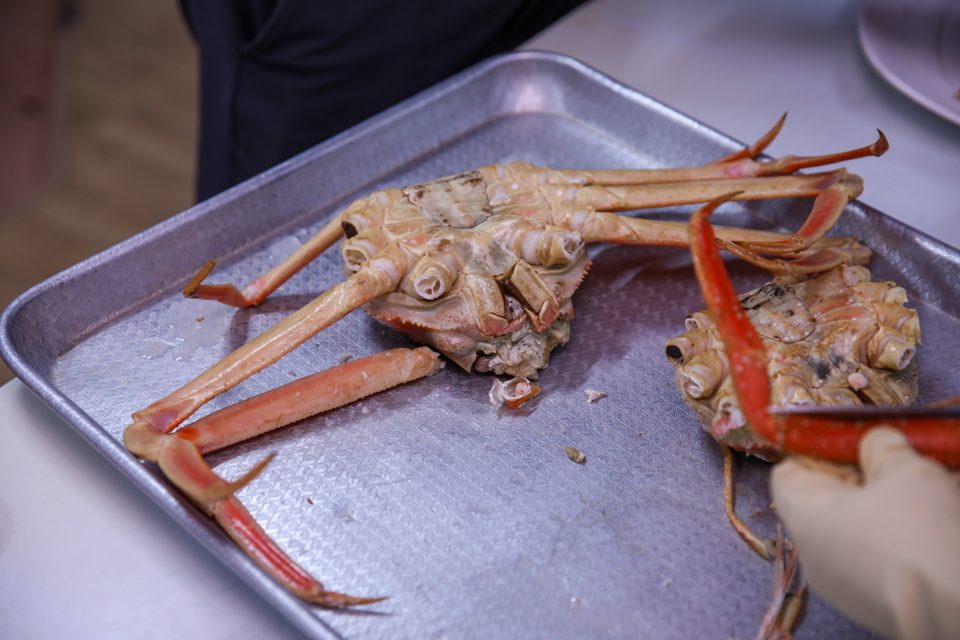
The word “yield” may be unfamiliar. It simply means how much meat has filled in inside the shell. It is not an exaggeration to say this is the whole crab business in one word.
A crab that has just molted has a shell that grew ahead of the meat inside. Pick one up and it feels light, and press a leg and it gives softly. Boil it and the meat floats loose from the shell, and watery liquid pours out. A crab that molted long ago is the opposite: the shell is hard and it feels heavy in the hand. Cut a leg open and the meat packs it so tightly that the cross section is sealed white.
This is the first thing we look at when we pick our stock at dawn. At the same weight, a different yield means a different amount lands on the customer’s table. On days when high-yield crabs come in, we post to our KakaoTalk channel first. The catch is small, so those crabs never sit long in the tank.
From the customer’s side, there is one thing to remember. Before you ask how many servings are in 1kg, ask whether this crab is a full one. Get that order backwards and every calculation that follows goes wrong.
Ordering guide by party size
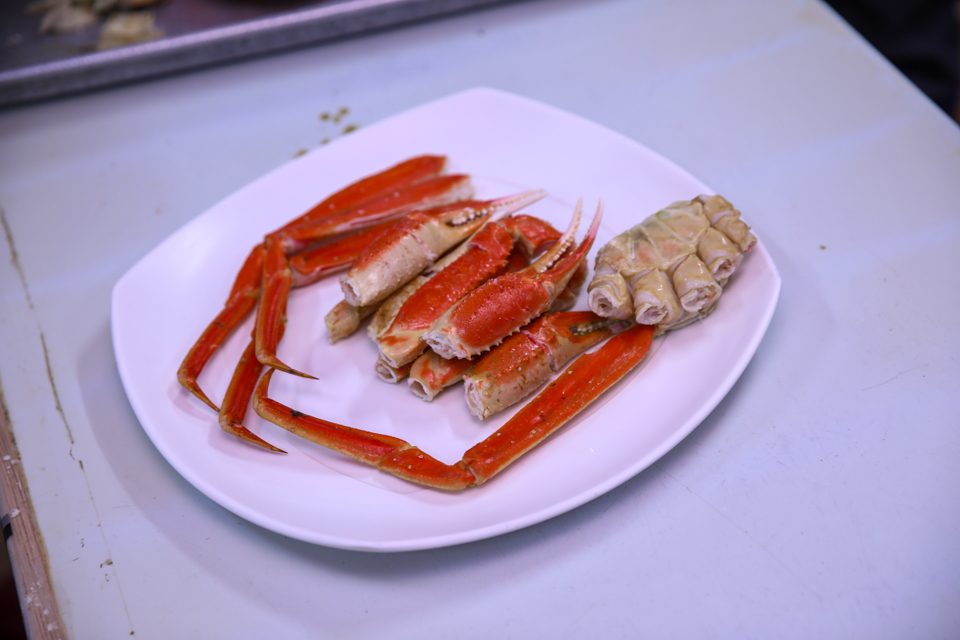
Still, you need a baseline, so here is the table I have settled on after watching customers’ tables for 25 years. It assumes the crab is the main event, with side dishes and a finishing course served alongside, the way we do it at our shop.
| Party size | Recommended weight | Number of crabs | Suited for |
|---|---|---|---|
| 1 person | Around 1kg | 1 crab | When you want a proper taste on your own |
| 2 people | Around 1.5kg | 1 to 2 crabs | A meal with drinks, the most common setup |
| 3 people | 2kg or more | 2 crabs | Plenty left over for crab-shell fried rice |
| 4 people | 2.5 to 3kg | 2 to 3 crabs | A family meal, children included |
| 6 or more | Head count x 0.6kg | Let’s discuss | Group dinners and gatherings, reservation recommended |
The part of the table worth noticing is that the weight per person drops as the party grows. Two people eat 1.5kg, but four people are often satisfied with 2.5kg rather than 3kg. With more people at the table there are more side dishes going around, and conversation slows down the pace of eating.
For families with children, count each child as half a person and you will be close. Kids eat the leg meat and mostly skip the top shell and the body. They collect their share from the fried rice instead.
How much meat each part gives you
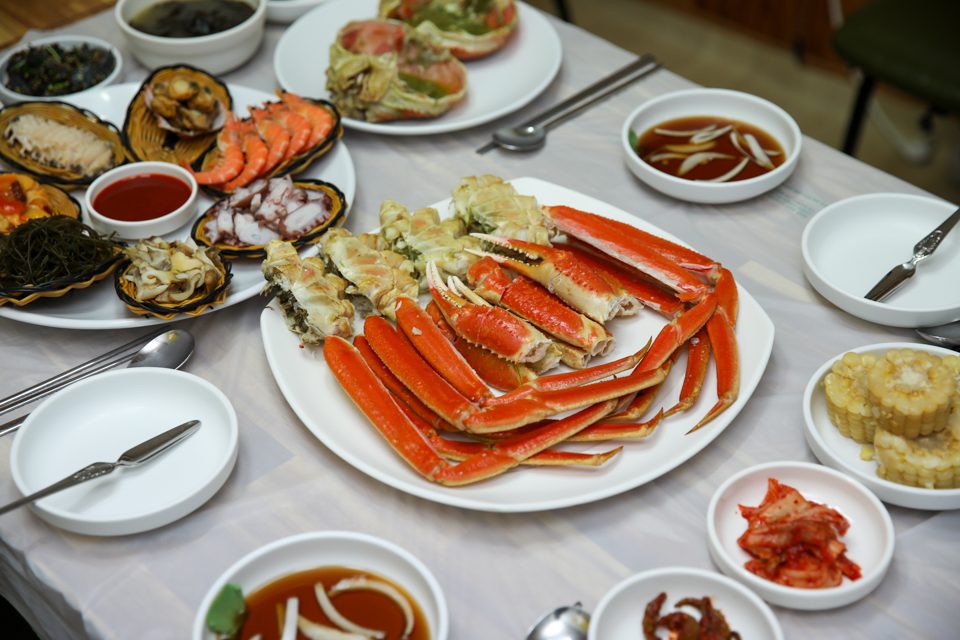
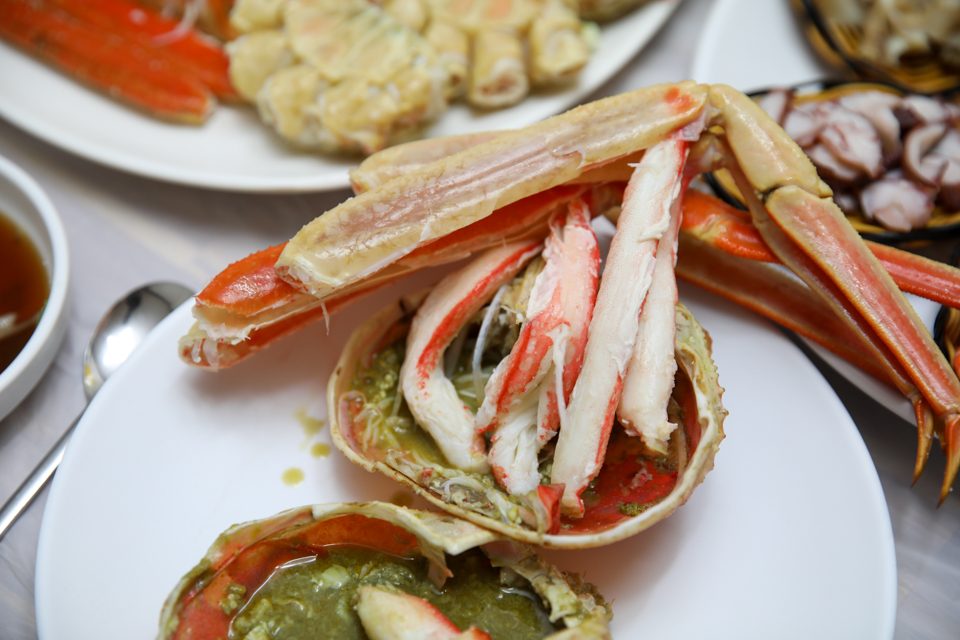
Break down a 1kg crab and the parts come out like this: eight legs, two claws, one body, one top shell.
Most of the meat is in the legs. The eight legs give you more than half of everything edible. The thick first segment is the prize, and the legs taper as you go toward the tips. The claws hold less meat, but the texture is firm and the sweetness runs deep, so many customers save them for last on purpose.
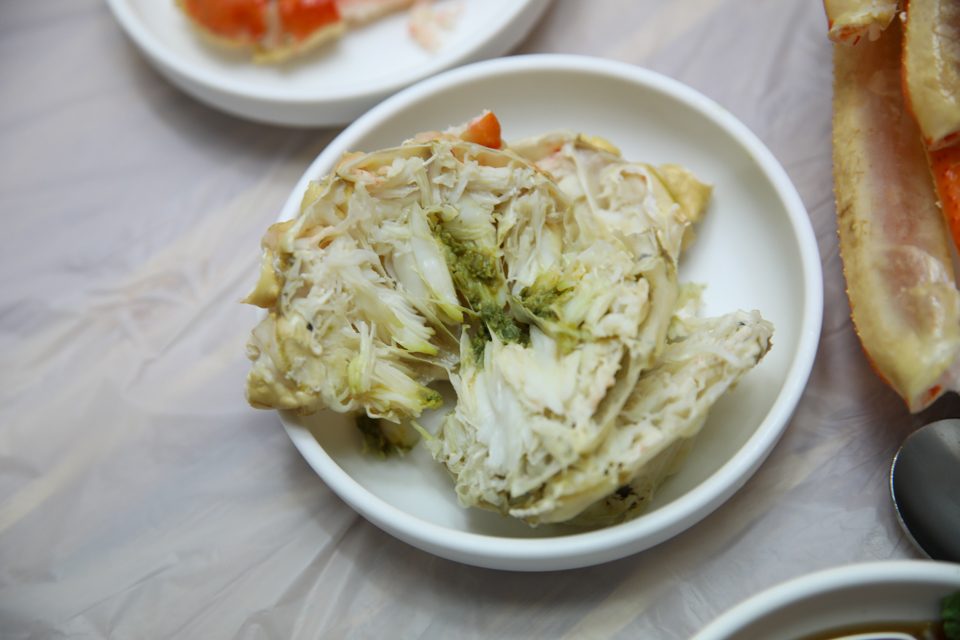
The body takes a little more work to eat. The meat sits inside a honeycomb of small chambers, and if you scrape with a spoon you get more out of it than you would expect. Throw it away because it is a bother, and you are throwing away a quarter of the crab’s meat. When we clean the crab we split the body in half for you, so all you need is a spoon.
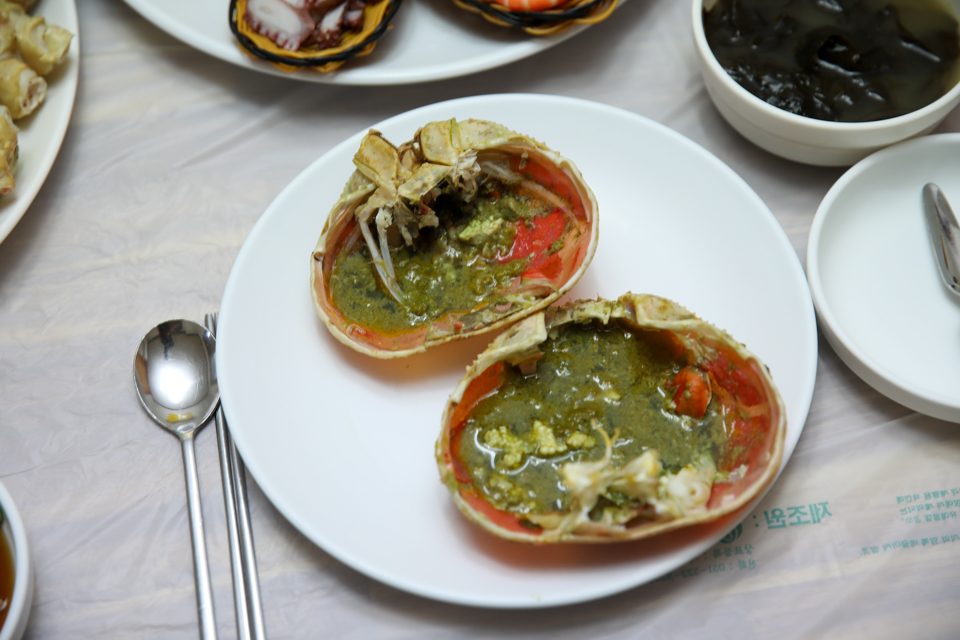
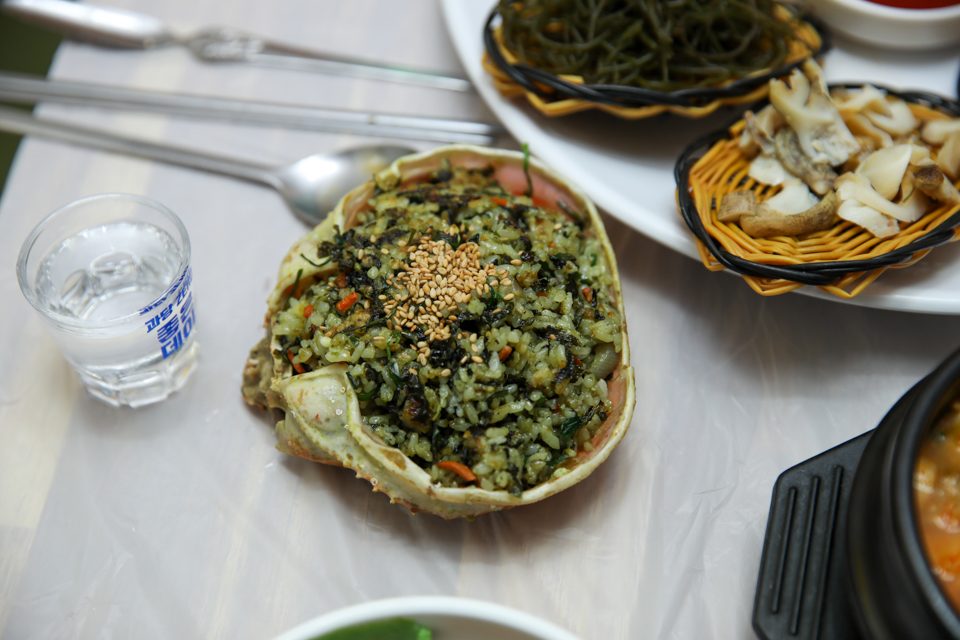
The top shell does not amount to much by volume, but it plays a different role. Gathering the tomalley and mixing it into rice is how a snow crab comes to a close. Only when you count that far does the answer to “how many servings” become complete.
Three things to check at the scale
These tricks work at any shop, not just ours. Check these three things before the crab goes on the scale and you will eat more for the same money.
First, lift it. Between two crabs of the same size, the heavier one is the fuller one. If it is big but light, you are holding an oversized shell. Ask the seller if you can lift it. If a shop refuses, take your business elsewhere.
Second, press the belly. Press the belly shell firmly with your thumb. If it holds solid, the crab is full of meat. If it sinks in, the crab has not filled out yet.
Third, watch how it moves. A crab standing up on its legs in the tank, or spreading its claws, is a crab with strength left. One sprawled flat on the bottom has been living in the tank for a long time, and the odds are high that it has thinned out accordingly.
If a crab passes all three checks, you can safely count 1kg as one adult’s portion and the numbers will hold.
How to factor in the side dishes
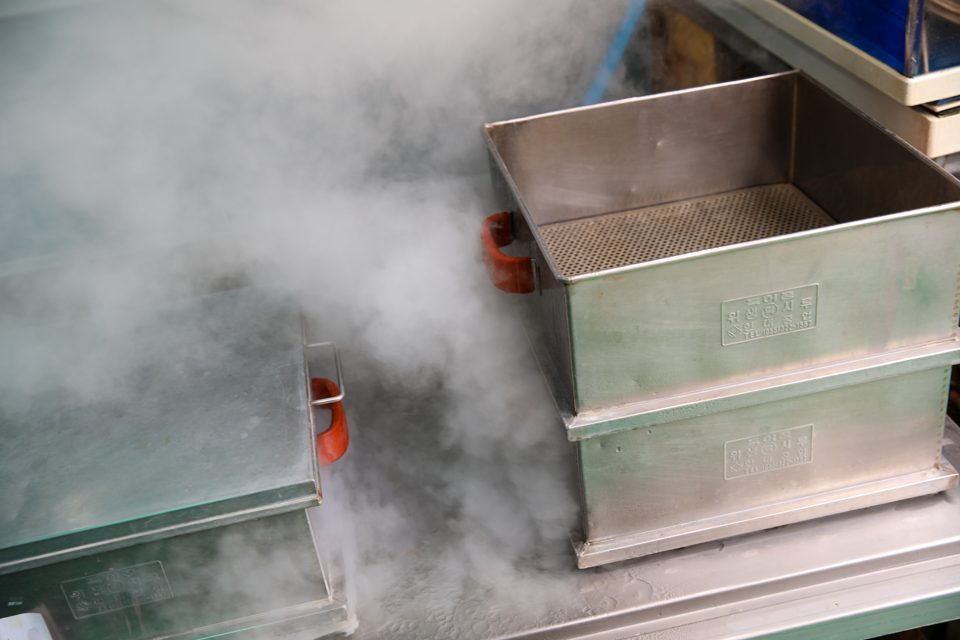
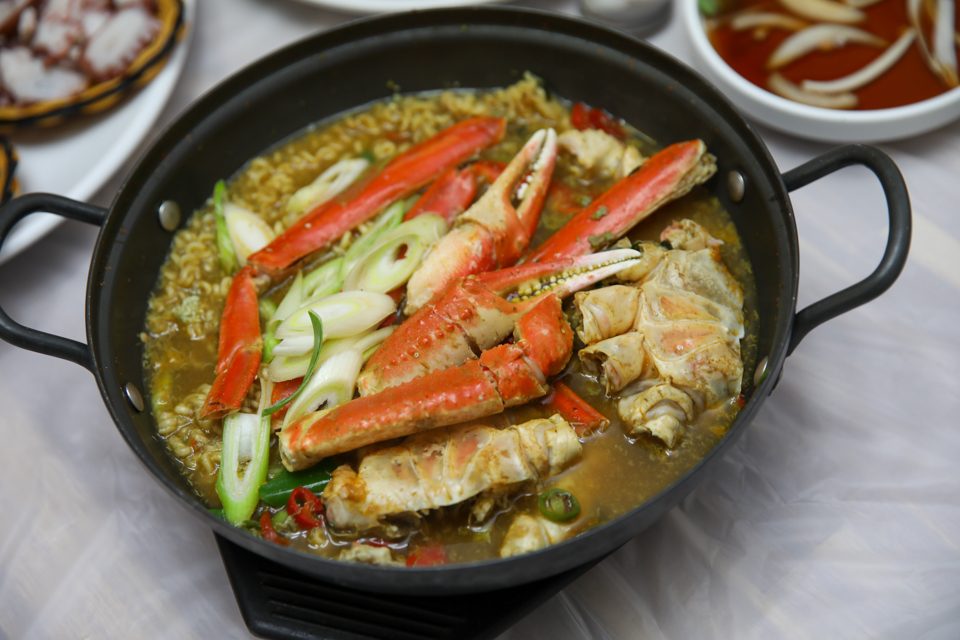
It is rare to eat crab and nothing else. At our shop, a spread of seafood side dishes goes down before the crab arrives, and after it comes the crab-shell fried rice and the crab ramyeon. With that lineup, you can trim a little off the weights in the table above.
On the other hand, if you have spent the whole day sightseeing and arrive hungry in the evening, or you plan a long night of drinking, it is better to order above the table. Crab is a pick-and-eat food, the meal runs long, and the longer it runs, the more you end up eating.
One tip: do not order everything up front. Start at the low end of the table. If it is not enough, you simply pick another crab from the tank. Since the crab is live and cleaned the moment you order, the wait for a second round is short. Adding is always better than leaving food behind.
When there is too much, and when there is not enough
Let me start with leftovers: we pack them for you. Take the picked meat home and it goes beautifully into fried rice or rice porridge the next day. Take it home shell and all, and the shells make stock for ramyeon. In summer, though, I do not recommend it if your trip home runs over an hour. Cooked crab meat spoils quickly at room temperature.
If you come up short, the answer is an extra order as I said above, but there is one thing to know. Late in the evening, fewer crabs are left in the tank and your choices narrow. If you are coming with a large group or arriving late, it is better to call ahead. Tell us your head count and we will set aside the crabs in the strongest condition from that day’s arrivals.
If not by weight alone, how is the price set
Skipping the question of price would leave this article half finished, so let me address it briefly. Live snow crab sells at market price. It changes daily with the catch and the weather, so we do not pin a number in advance. But on any given day, the scale is read in front of the customer, and we tell you that day’s rate exactly as it is.
If you are curious, call or message us on KakaoTalk before you come. We will tell you the rate along with the condition of that day’s stock. And screening out shops that play games with weight is simple. Do they weigh the crab in front of you, and do they shake the water off before weighing? Those two checks are all you need.
How the portion shifts with the season
The same 1kg lands differently depending on when you eat it. In the stretch from winter into spring, a 1kg snow crab gives you the most meat of the year. The crabs are building up reserves ahead of spawning. Cut open any leg and the cross section is packed solid white, and the eating you get per unit of weight comes out honest.
Early winter is when the season has just opened, and the variation between individual crabs is wide. Full crabs and half-filled crabs share the same tank, so a trained eye earns its keep most in this period. This variation is exactly why we go and select our stock ourselves every dawn. Even choosing only the good ones, the day’s intake varies, so some days the tank is full and some days it is at half.
In summer, the closed fishing season falls in the middle, so red snow crab and king crab take the snow crab’s place. To customers who come then, I do not push them to insist on snow crab. The crab that fits the season is the answer for that season. Ask before you visit and we will tell you what is good right now, based on what is in the tank that day.
Compared with red snow crab and king crab
Once you start calculating servings, you naturally end up comparing with other crabs. Let me cover just three points.
Red snow crab has a thinner shell than snow crab and carries more water. For the same 1kg, count on getting less actual meat than from a snow crab. In exchange, the meat is soft and deeply sweet, so it shows its true worth in ramyeon or a hot pot rather than steamed.
King crab is the opposite. The legs are thick and the meat-to-shell ratio is high, so at the same weight you eat more than you would from a snow crab. If two of you are having king crab, you start from around 2kg, because each crab is so large that splitting one into small units is difficult. It is not the snow crab math of adding one crab at a time; it is a matter of deciding the size of a single crab from the start.
For first-time visitors who are curious about both, I suggest a half-and-half spread of snow crab and king crab. Compare the sweetness of one against the chew of the other at the same table, and you will know your own preference for next time.
The math for takeout and delivery
If you are taking the crab home rather than eating at the shop, the calculation needs a small adjustment. For takeout there are two ways: steamed with the meat picked out for you, or carried home live. Picked meat shrinks in volume so it fits easily in the fridge, but it should be eaten the same day.
For delivery, we ship the crab live in insulated cold packaging. Order before noon on a weekday and it leaves that day and arrives the next. If you plan to steam it at home, I suggest ordering a bit more weight than the in-shop guideline. Moisture cooks off during steaming, and at home there are usually no side dishes, so all the eating falls on the crab. For two people, 1.5kg at the shop feels about the same as 2kg at home. If you are eating alone, one 1kg crab is the basic unit for delivery too.
Three real tables from recent weeks
Numbers alone will not give you a feel for it, so let me set down three recent customers’ tables exactly as they happened. Find the one closest to your situation and the math gets easy.
Case one. A business traveler alone. He came in around seven on a weekday evening and ordered one 1kg crab. A bottle of soju alongside. He worked slowly through the eight legs over forty minutes, ate half the body, then mixed rice into the top shell. The remaining body meat he took home packed. For him, 1kg turned out to be exactly a meal and a half.
Case two. A couple on their wedding anniversary. They chose a single 1.5kg crab. The steamed crab went out while they were working on the side dishes, and the two of them sat for an hour and a half. They split the legs and claws evenly and ordered one fried rice to share. On their way out they said, “We almost ordered 2kg worrying it would not be enough, but this was right.” This is why 1.5kg for two is the most common correct answer.
Case three. A grandmother’s 70th birthday, family of eight. Six adults and two children. They called ahead with the head count, so I had 4.5kg ready across three crabs. The children ate leg meat as the adults picked it for them, and they ordered two bowls of fried rice. Eight people did not run short on three crabs because the side dishes and the finishing course carried their weight. The table’s principle, that weight per person falls as the party grows, works in practice exactly like this.
The right order for eating a whole crab
The same amount of crab satisfies differently depending on the order you eat it in. Here is the order I have found works well after 25 years of setting tables.
Start with the legs. While the steam is still rising, go for the thick first segments. Snow crab meat grows sweeter as it cools, but the texture it has while hot exists only in that moment. When about six of the eight legs are done, I suggest moving to the claws. Claw meat is firm-grained, which makes it a good mid-course change of pace.
Save the body for the later stretch. It is spoon-scraping work, so it can wait until your hands are tired, and by then the tomalley in the top shell has cooled to just the right point. Last comes the top-shell rice. Mix rice into the tomalley, use the two legs you saved as your side dish, and one 1kg crab flows from start to finish like a course that was designed that way.
Eat in this order and a whole crab never gets tedious even alone, and in a group the parts get distributed naturally.
Common mistakes in serving math
There are calculation errors I see repeated in front of the tank. Know them in advance and ordering gets easier.
First, plugging in the head count directly. Six people came, so let’s order 6kg. Eat that way and you will have leftovers without fail. The more people, the lower the consumption per person. For six, the right move is to start inside 4kg and add if it runs short.
Second, counting children as adults. Count elementary-school age and under as half a person. However much a child loves crab, their picking speed cannot keep up with an adult’s.
Third, leaving the side dishes out of the math. If the table runs from side dishes through fried rice and ramyeon, the low end of the table’s weights is plenty. Crab as a single dish and crab as part of a full spread are two different calculations.
Fourth, not thinking about tomorrow. On the flip side, ordering generously with a plan to take some home is a strategy too. Picked crab meat makes an excellent base for next-day porridge or fried rice. That is not leftovers; that is splitting one order into two meals.
Worth knowing before you visit
Here are a few practical points that connect directly to the serving math.
Weekday daytime is the most relaxed window. The tank holds the most crabs then, so your choices are widest, and we have more time to spend on cleaning and preparation. Weekend evenings are our busiest hours, so for parties of four or more, calling ahead makes things easier on both sides. Tell us your head count and arrival time, and we will set aside the day’s strongest crabs and hold a table.
If you are coming from far away, take the Donghae Line and you can walk from Gijang Station to the market. If you drive, use the public parking near the market; late afternoon is easier than midday, when you compete for space with the market shoppers.
If you plan on takeout or delivery, size the weight one step above the in-shop guideline, as I wrote earlier. And for delivery, just remember that ordering before noon on a weekday is the cutoff for same-day shipping. Talk to us in 1kg units of snow crab, and we will combine crab counts to match the state of the tank that day.
Each size has its own character
Having covered weight, I have to cover size for the picture to be complete. The same species behaves differently at the table depending on the size of the individual crab.
Small crabs around 500g have thin legs, so there is less pleasure in picking them. On the other hand, you can lay out several at once, which actually makes them better suited for soups and stews. Some solo customers order two of this size, but at the same total weight I tend to recommend one large crab instead. The work doubles while what reaches your mouth stays about the same.
Crabs around 1kg strike the balance I trust most at the table. The legs are about as thick as a thumb, so the picking is satisfying, and this size is also the upper limit of what one person can manage alone. This is why a single 1kg snow crab serves as the reference point for the question of “how many servings.”
Past 1.5kg, a single leg grows thicker than an adult’s index finger. This class is well suited to sharing between two, and the meat comes in large flakes, so the chew is noticeably different. Crabs of 2kg and up do not come in often, and on days they do, our regulars hear from us first. At this size it is less a weight calculation than an encounter, a matter of “look what came in today,” so when you see one, that day is your chance.
If I compress the size principle into one line, it is this: the fewer the people, the bigger the single crab; the more the people, the more mid-sized crabs. Lay this over the earlier table and ordering becomes much simpler.
What 25 years of this question have taught me
We did not always answer “how many servings” at this length. In my early years I cut it short too: “1kg feeds one.” But I kept watching the tables that followed that answer go wrong. Some tables had food left over, which stung; some ran short, which embarrassed everyone.
Looking back, the problem was not the answer but the question being too lumped together. The same party of two differs between a lunch crowd and an evening drinking crowd, between someone tasting snow crab for the first time and someone who comes every year. So at some point I started asking back. How many are coming, is it a meal or drinking food, are there children. With just those three answers, the weight comes out almost exactly right.
The table and the cases in this article are what those questions, asked over and over, added up to. The one-line answers floating around the internet, like “1kg of snow crab is two servings,” are not wrong so much as half right. The other half is filled in by the situation of the person eating. Filling in that half is the seller’s job, and that is why the conversation before an order runs a little long at our shop. In all these years, no customer has lost out because it ran long.
If there is one more thing I have learned, it is that customers who under-order and add end up more satisfied than customers who over-order and leave food behind. An added crab carries anticipation; a leftover half carries regret. That is why, today as always, I recommend starting from the low end of the table.
The 30-second version to recall before ordering
Here is everything above, compressed so you can call it up in front of the tank.
- The meat you actually eat is a third of the weight. 1kg of crab means around 300g of meat
- Start from 1kg for one, 1.5kg for two, 2.5kg for four
- Count a child as half a person
- Three checks before choosing: lift it, press the belly, watch it move
- With lots of sides, take the low end of the weights; for a drinking table, the high end
- If it runs short, adding is the answer; do not leave food behind, split it into two meals
- If you plan to eat a lot, call ahead with your head count
Keep these seven lines in mind and you will hold steady in front of any shop’s tank.
How to store leftover crab
This is the storage guide for when the serving math slips a little and crab remains. A short rundown so nothing goes to waste.
Cooked crab meat keeps one day refrigerated in an airtight container, and up to two weeks frozen. Do not thaw frozen meat; drop it into fried rice or porridge still frozen and the texture survives. Do not throw the shells away either; boil them once and draw a stock. Use it in place of plain water for ramyeon and you recreate most of the crab ramyeon you had at the shop.
What to watch out for is leaving it at room temperature in summer. Cooked crab meat becomes unsafe past two hours unrefrigerated. If you have a long day planned after picking up your takeout, bring a cooler bag, or tell us and we will pack ice in with it.
Frequently asked questions
How many people does 1kg of snow crab feed?
It fills one adult properly. For two people having it as a meal, I recommend around 1.5kg. If the table includes side dishes and fried rice, 1kg often satisfies two people without feeling short.
How much food is 1kg of snow crab, really?
With the shell and moisture removed, the actual meat is around 300g. A bowl of rice is 200g, so eating crab alone with no sides, it is plenty for one meal. Because picking the meat takes time, it feels like more than the number suggests.
How big is a 1kg snow crab?
With the legs spread, it approaches the length of an adult’s arm, and the thick first leg segment is about the size of a thumb. This class is the upper limit one person can manage alone, and the size where picking the meat is most rewarding.
How many crabs is 1kg?
Usually one. In most cases 1kg refers to the weight of a single crab, though some shops combine several small crabs to make up 1kg. When you order, it is worth confirming whether the figure is per crab or a combined total.
How many calories are in 1kg of snow crab?
Counting only the meat you eat, it is around 70kcal per 100g, so even finishing the full 300g from a 1kg crab comes to a little over 200kcal. It is low in fat and mostly protein, so it sits light for the amount you eat.
How is the price of 1kg of snow crab decided?
It is market price. It changes daily with the catch and the weather, so we do not fix a number in advance. The scale is read in front of the customer and we quote that day’s rate as it is, so feel free to call or message us on KakaoTalk before you come.
Which is better, one 1kg crab or two 500g crabs?
At equal yield, the single large crab is the better choice. The legs are thick, the meat comes out easily, and the grain of the meat is finer eating. Two small crabs double the work of cleaning and picking.
How do I spot a high-yield snow crab?
At the same size, the heavier one; the one whose belly holds firm when pressed; the one standing up on its legs in the tank. Pass two of the three checks and you can consider it above average.
Can I come alone and order 1kg?
You can. We have a steady stream of customers who come alone and finish a whole crab. If anything remains, we pick the meat and pack it for you, so there is no need to feel any pressure.
How many kg for a family of four with two children?
Count the children as half a person each, making it three people’s worth, so 2kg or more will do. Children mostly eat the leg meat and fill up on the fried rice, so they need less than you would think.
Does the crab lose weight when steamed?
It does. Moisture escapes during steaming. That is why the standard is to weigh the crab live, before cleaning, in front of the customer, and why you should also watch whether the water is shaken off before weighing.
Is it true there is nothing to eat in the body?
No. The body holds about a quarter of the crab’s total meat. It is only that the chambered structure makes it fiddly to pick; split in half, as we serve it, you can scrape it out with a spoon.
Does the serving math change for king crab instead of snow crab?
It changes. King crab has thick legs and a high proportion of edible meat, so at the same weight you eat more than with snow crab. But each crab is large, so for two people you start from around 2kg.
Does an additional order take long?
We pick straight from the tank and clean it on the spot, so it is not much different from the first order. But late in the evening fewer crabs remain and the selection narrows, so if you plan to eat a lot, it is better to tell us your head count in advance.
To sum it up
One kilogram of snow crab is a solid portion for one adult. Start from 1.5kg for two and 2.5kg for four, and add if it runs short; that approach does not fail. And before you weigh anything, check first whether the shell is full. Keep to that order and you will not lose out wherever you eat.
Our shop is inside Gijang Market. The name is Gijang Cheonghaewang Daege, the address is 12 Eupnae-ro 104beon-gil, Gijang-eup, Gijang-gun, Busan, and the phone number is 0507-1490-5702. We are open every day from nine in the morning to nine at night, and you can always ask by phone or KakaoTalk about the condition of the day’s stock.
If you are planning a day out in Gijang, I have laid out a visiting route in the article A one-day itinerary of places worth visiting in Gijang, Busan.
Jung Young-jin
Gijang Cheonghaewang Daege · Owner · 25-year live seafood vendor